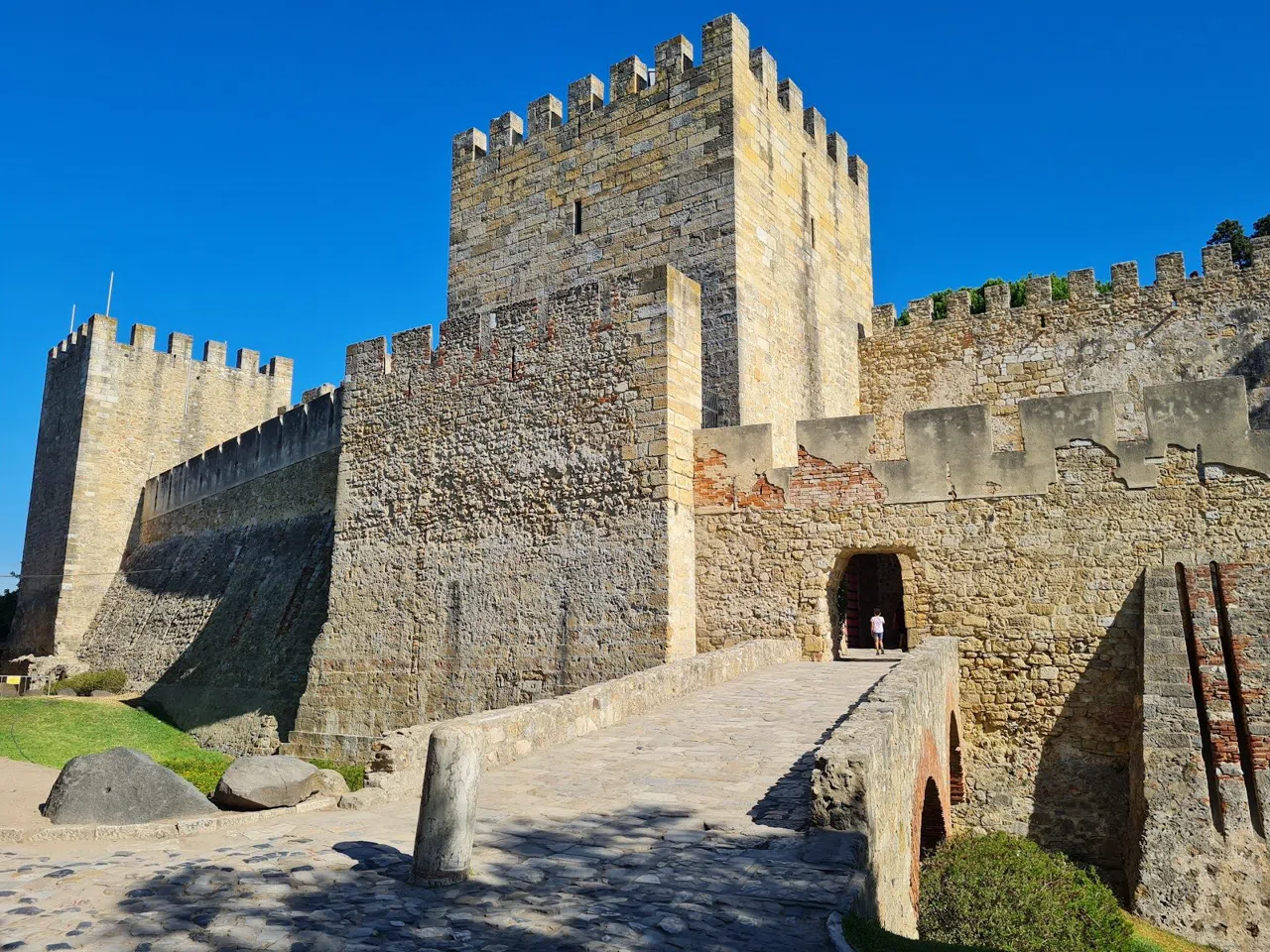

From the cathedral door to the castle gate is about fifteen minutes of steady climbing, most of it on cobbles laid at an angle that punishes flat soles. On an August afternoon the last stretch is the part people remember. The crowd waiting at the top is not bad luck, it is arithmetic: nearly everyone arrives between eleven and three, nearly everyone walks the same ramp, and almost nobody uses the two free lifts that take half the climb out of the day. Get those three decisions right and Castelo de São Jorge goes back to being a calm couple of hours with the river laid out in front of you.
What is behind the walls
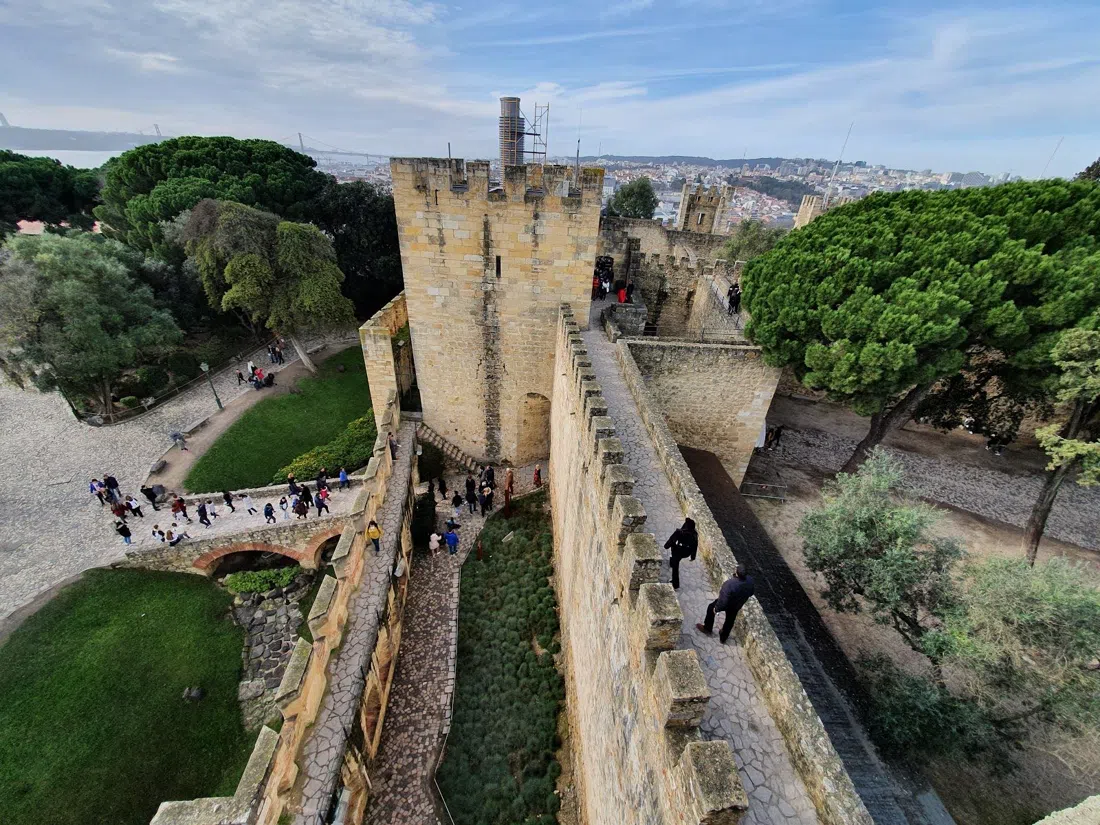
Castelo de São Jorge (Castelo, the hilltop directly above Alfama) is three sites sharing one enclosure. There is the ring of walls and towers you can actually walk, with the ramparts giving you the city in sections instead of all at once. There is the archaeological site, a dug-out slope where the layers of the hill sit on top of each other and are labelled as such. And there is the permanent exhibition, which is the part most people skip and the part that makes the dig readable.
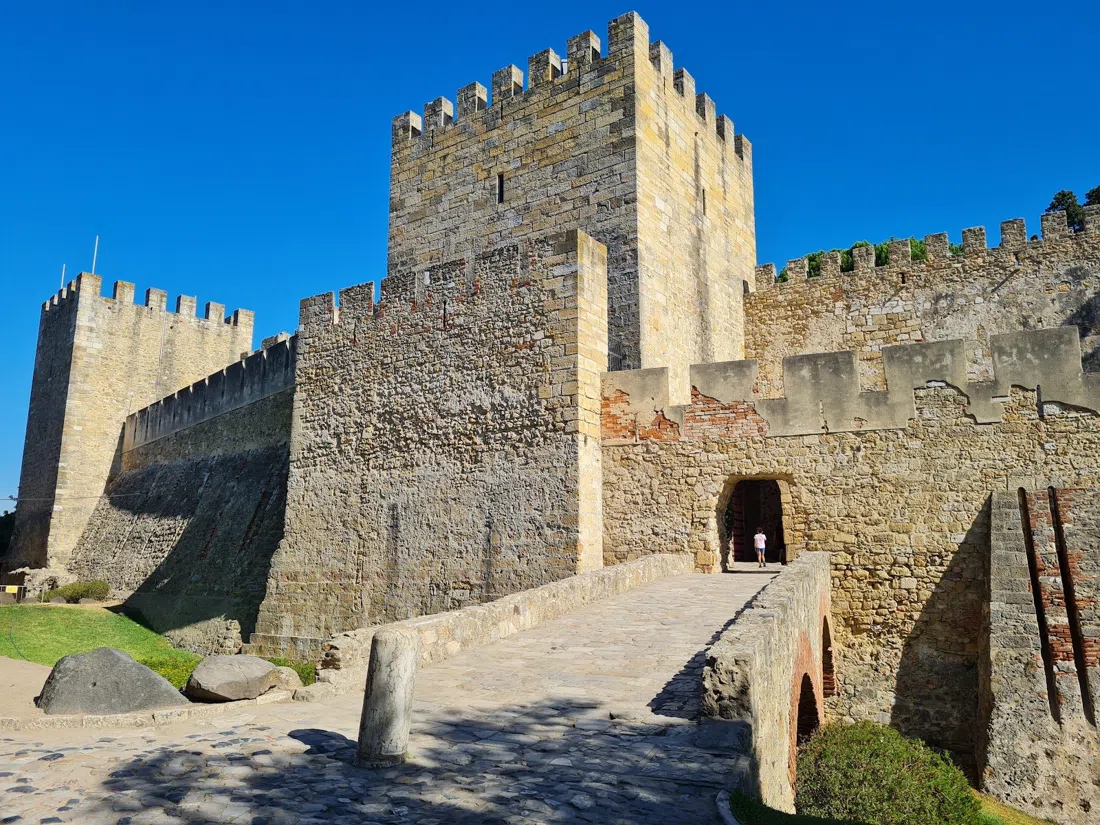
Admission is €17 for adults, €8.50 for ages 13 to 25, €14 for over-65s, free for under-12s and free with the Lisboa Card. School groups pay €1.50 per student. Worth knowing before you shop around: the rate a tour operator pays is the same €17 as a walk-up, so an organised visit is buying you a guide and a route, not a cheaper door.
The ticket also covers two guided elements. The 'Discovering the Castle' tour is included but capped, so a large party gets split into smaller ones instead of moving as a block. The other is the Camera Obscura, which most day-trippers walk straight past.
The one part of the castle that runs out of slots
The Camera Obscura at the Torre de Ulisses (inside the castle grounds) is a periscope and mirror rig in the top of a tower that throws a live, moving image of the city onto a white dish while a guide narrates it. It is included in the €17, but it runs as a timed twenty-minute session in a small dark room, and that room capacity is the constraint. It is the one part of the castle that genuinely sells out of slots.
So sign up at the tower when you arrive, not when you happen to wander past at three in the afternoon. And check the season, because the hours are short and they move: roughly 11:00 to 13:00 in January, February and October to December, stretching out to 11:00 to 16:00 in May through August. It also goes dark in bad weather, since there is nothing to project when the sky is flat grey.
How long to allow
Walls, archaeological site and exhibition at an unhurried pace is about ninety minutes. Add the Camera Obscura session and the included tour and you are at two and a half to three hours, which is the right figure to plan around.
Summer has a timing trap in it. The gates are open 09:00 to 21:00 from March to October with last entry at 20:30, but the wall-walks and towers shut before the gates do. Arrive at 19:30 in July and you have bought yourself the view and the terrace, not the ramparts. From November to February the castle runs 09:00 to 18:00, which makes the late-afternoon plan impossible anyway. It opens daily except 1 January, 1 May, 24 and 25 December and 31 December.
Getting up the hill without wrecking your legs
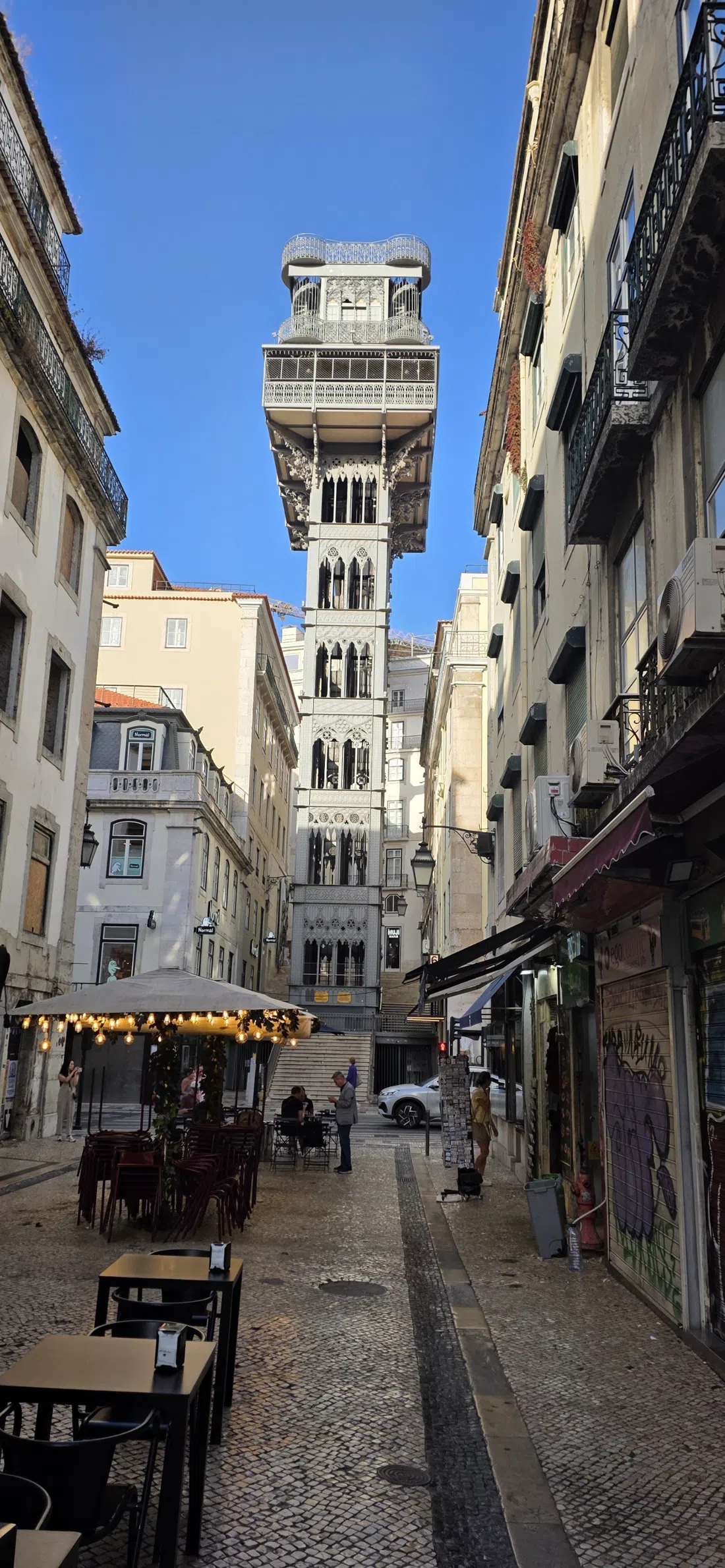
The single most useful thing to know is the Elevador do Castelo (Rua dos Fanqueiros, Baixa, up to Costa do Castelo). Two public lifts chained together, no booking, no fare, daily 07:00 to 21:00. They lift you from the flat grid of Baixa to the Mercado do Chão do Loureiro terrace and leave you a short, mostly gentle walk from the castle gate instead of a twenty-five minute climb. The cars are small, so a group of eight goes up in shifts.
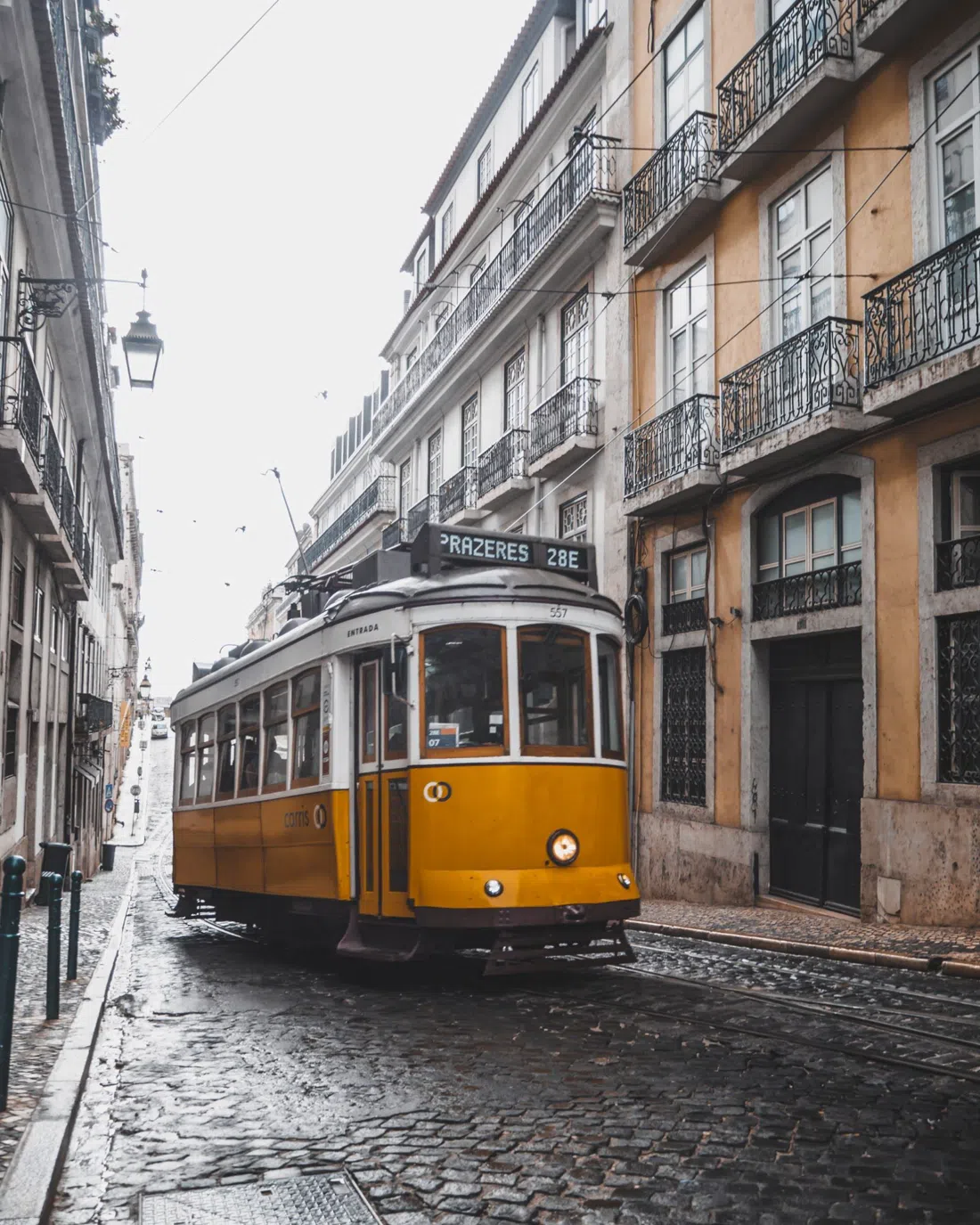
Tram 28 (Carris line 28E) is the famous alternative and the worst one between 09:00 and 18:00. It is €3.30 bought on board, €1.90 with a Navegante or Viva Viagem card, €7.25 for a 24-hour Carris and Metro pass. There is no group provision at all, it is standing room by the time it reaches the hill, and pickpocketing on it is constant and real. If you want the ride, board at Prazeres at the far end where you can get a seat, or take it at the end of the day when you are going downhill and no longer care how long it takes. Bus 737 climbs the same hill with far less theatre, and walking beats both if the weather is reasonable.
The walk up through Alfama
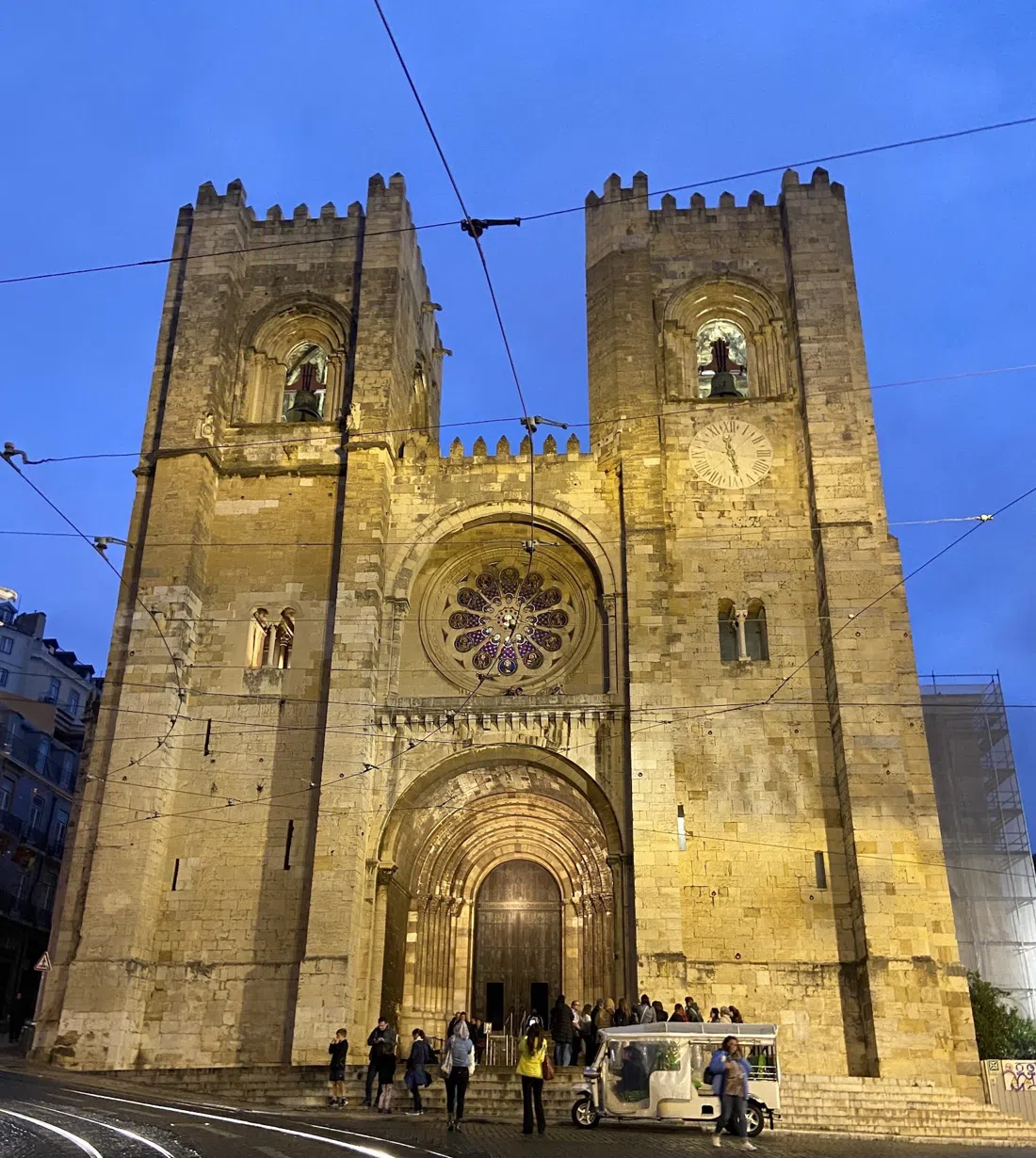
If you do walk, the climb is better as a sequence of stops than as one push. Start at Sé de Lisboa (Alfama, at the foot of the castle hill), €7 adult and €5 reduced, free under 6, Monday to Saturday 10:00 to 18:00 from November to May and 09:30 to 19:00 from June to October, closed Sundays and holy days, last entry 45 minutes before closing. The cloister is the reason to go in. Walkways run over an open excavation and they are narrow enough that everyone ends up moving the same direction whether or not anyone said so.
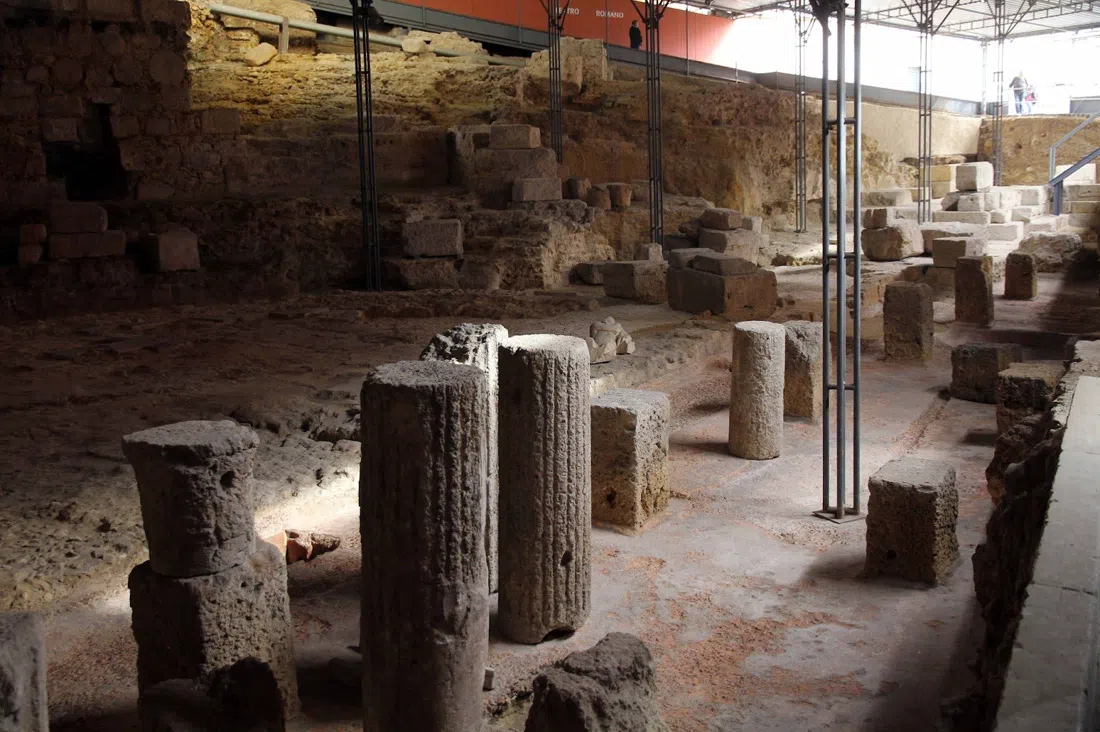
A few minutes below the cathedral, Museu de Lisboa – Teatro Romano (Alfama) is a 30 to 40 minute stop over an Augustus-era theatre rebuilt under Nero. Entry is a low single-figure euro sum on the Museu de Lisboa tariff and free with the Lisboa Card. Do it before the castle rather than after, because it teaches you how to read a stacked site and the castle's own dig then makes sense at a glance.
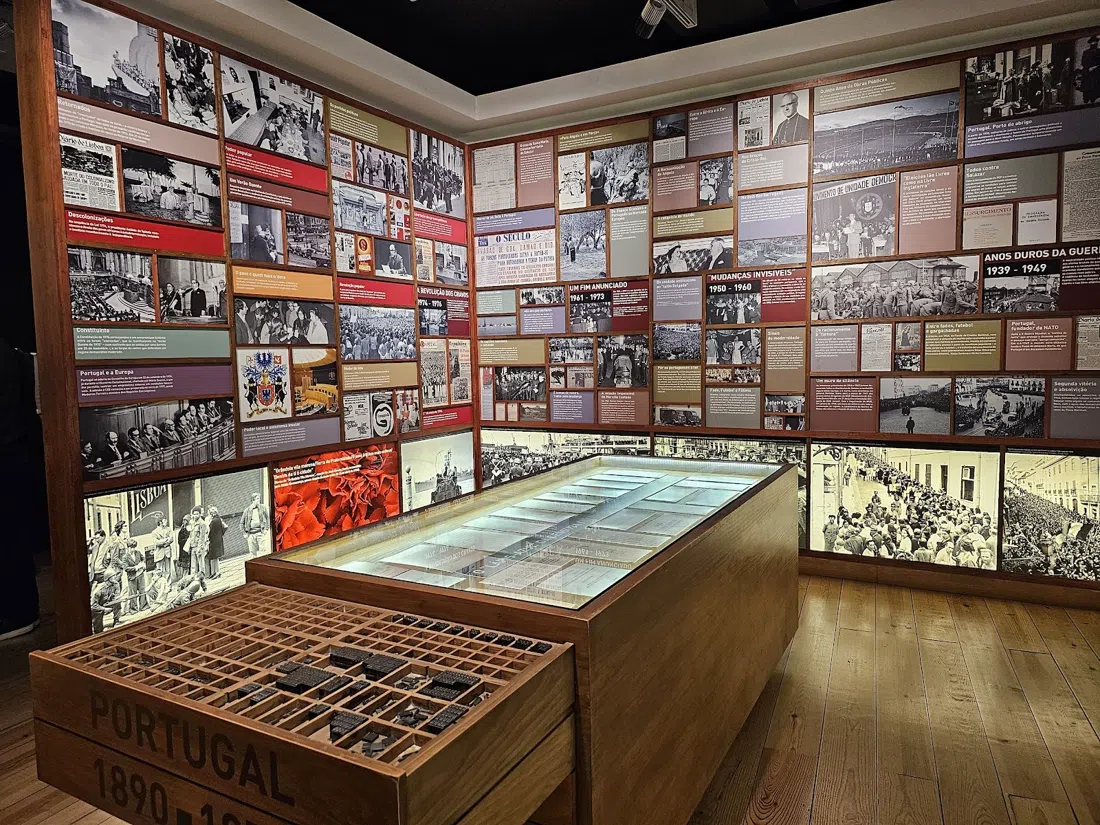
On the same climb, Museu do Aljube – Resistência e Liberdade (Alfama) tells the story of the Estado Novo inside the building where the regime held its prisoners. €4 adult, €2 for ages 13 to 25, €2.80 for seniors, free under 12, closed Mondays, 10:00 to 18:00. The building is small and the stairwells are tight, so a group should book and go in as two halves. It is the serious hour in a day otherwise spent looking at views, and the day is better for having it.
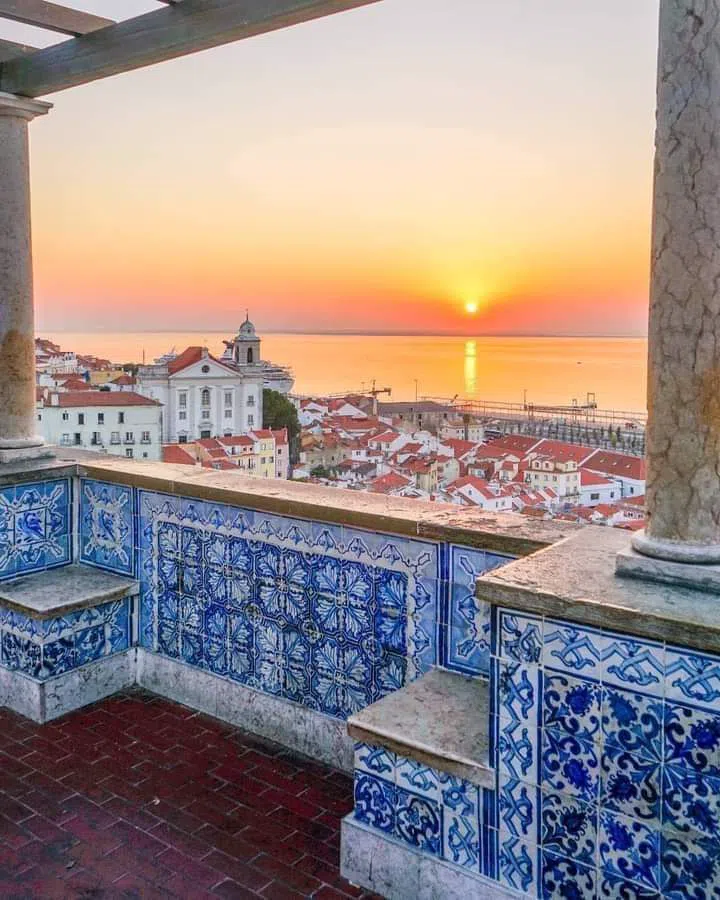
Higher up, Miradouro de Santa Luzia (Alfama) is free, open terrace, no closing time, with tiled panels along the pergola. One of them shows the 1147 siege of the castle you are about to walk into. Thirty seconds uphill from it, Miradouro das Portas do Sol (Alfama) is the wider terrace with the kiosk, drinks around €3 to €6, no door policy and no ticket. Early morning is the hour here, with the sun behind you over the river; it clogs at the balustrade every time tram 28 unloads.
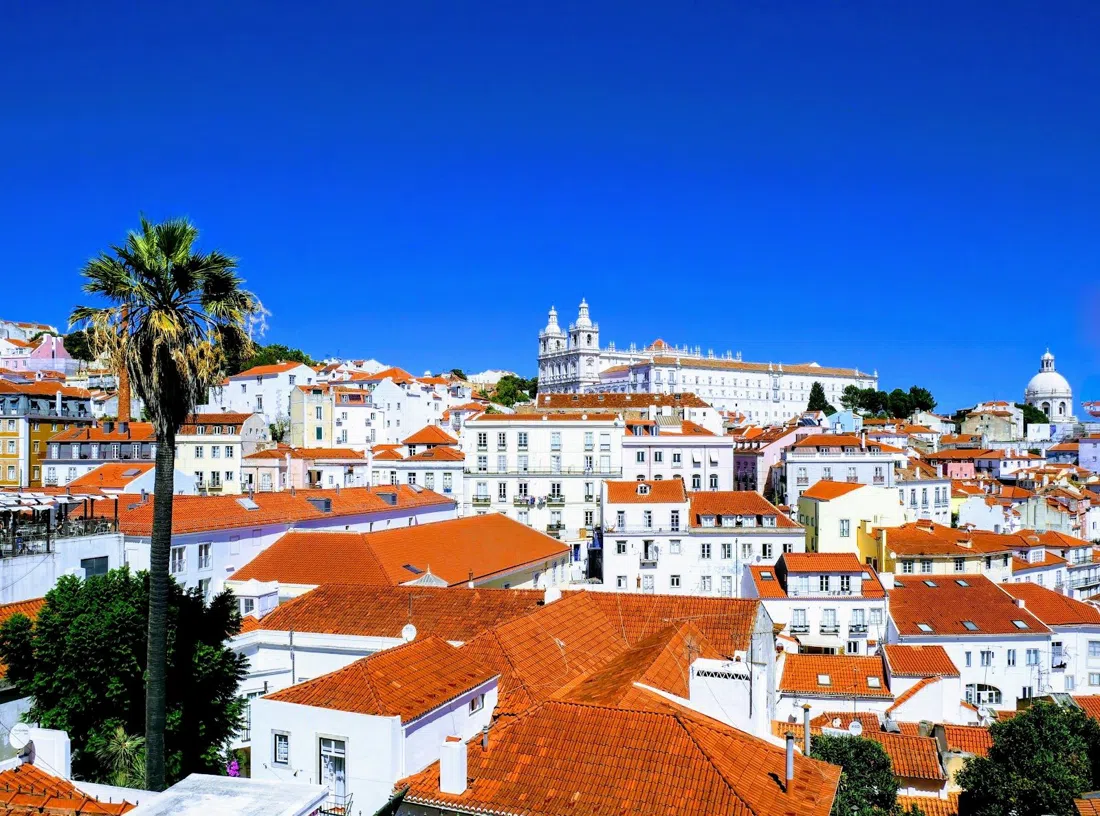
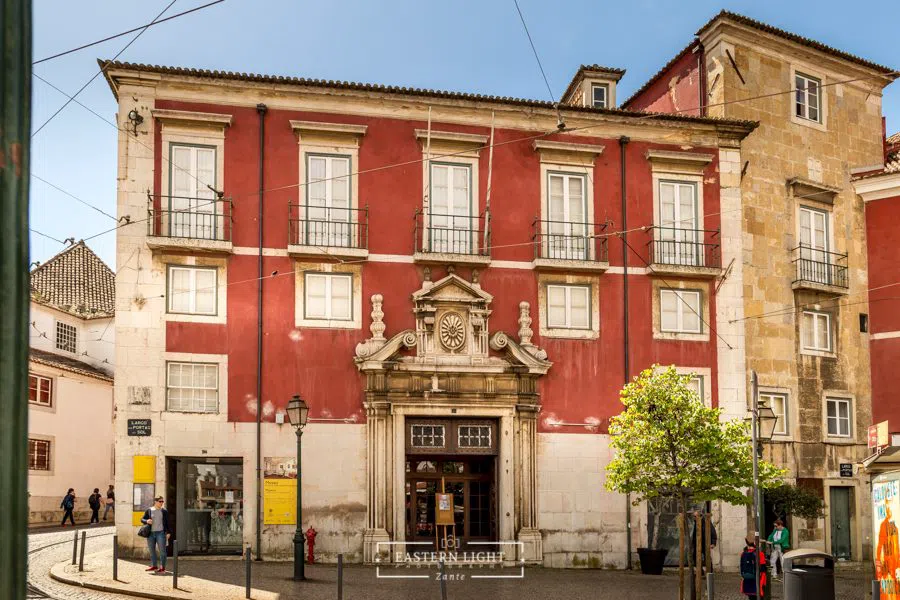
Right on Largo das Portas do Sol, Museu de Artes Decorativas Portuguesas (Alfama), run by the Fundação Ricardo do Espírito Santo Silva, is a working craft school as well as a collection. €10 adult, €5 students and over-65s, €8 with the Lisboa Card, free under 14. Guided tours run daily at 11:00 and 15:00 in Portuguese and English for up to 18 people, and anything larger has to be booked ahead. Closed Tuesdays, 10:00 to 17:00 October to May and 10:00 to 18:00 June to September. It is the hour to hold in reserve for rain.
Tickets at the door against booking ahead
There is no scarcity problem at this castle. There is a clustering problem. The ticket office sells the same €17 ticket all day, and the line is long from late morning until mid-afternoon because that is when the tram, the tour coaches and the cruise arrivals all land within the same two hours. Turn up in the first hour after opening, or in the last two hours of a summer day, and the queue is usually a few minutes.
Booking ahead buys you two different things. One is a slot that survives a bad decision about when to arrive. The other is a guide, which is a genuine improvement on a site whose ruins are not self-explanatory. A guided full-day option covering the castle and more besides operates seven days a week and starts from 58 USD per person, and that kind of itinerary is rated 4.8 out of 5 across 7,889 traveller reviews, so plenty of people have walked that route before you. Whether it is for you depends on whether you want the hill as part of a longer regional day or as the afternoon you spend on it.
If you already hold a Lisboa Card, the castle is free with it, the Roman theatre is free with it, the decorative arts museum drops to €8, and the monastery below gives 25% off, which is usually enough to settle the card question by itself.
Access, groups and what the site asks of you
The castle is a medieval hilltop, and it behaves like one. Cobbles throughout, a ramped approach, and rampart stairs that are uneven and in places narrow. The flat, comfortable ground is the main terrace and the area around the ticket office, and that terrace happens to hold the best of the view, so a visit that skips the walls is still a real visit.
For groups, the constraints are all about capacity rather than welcome. The included tours are capped, so large parties get split. The Camera Obscura room is small, which is why signing up early beats arriving together at 15:00. The lifts run in shifts. Santa Luzia has a small footprint and fills with one arriving group, so stagger it. Tram 28 has no group provision worth the name.
Eating and drinking on the hill
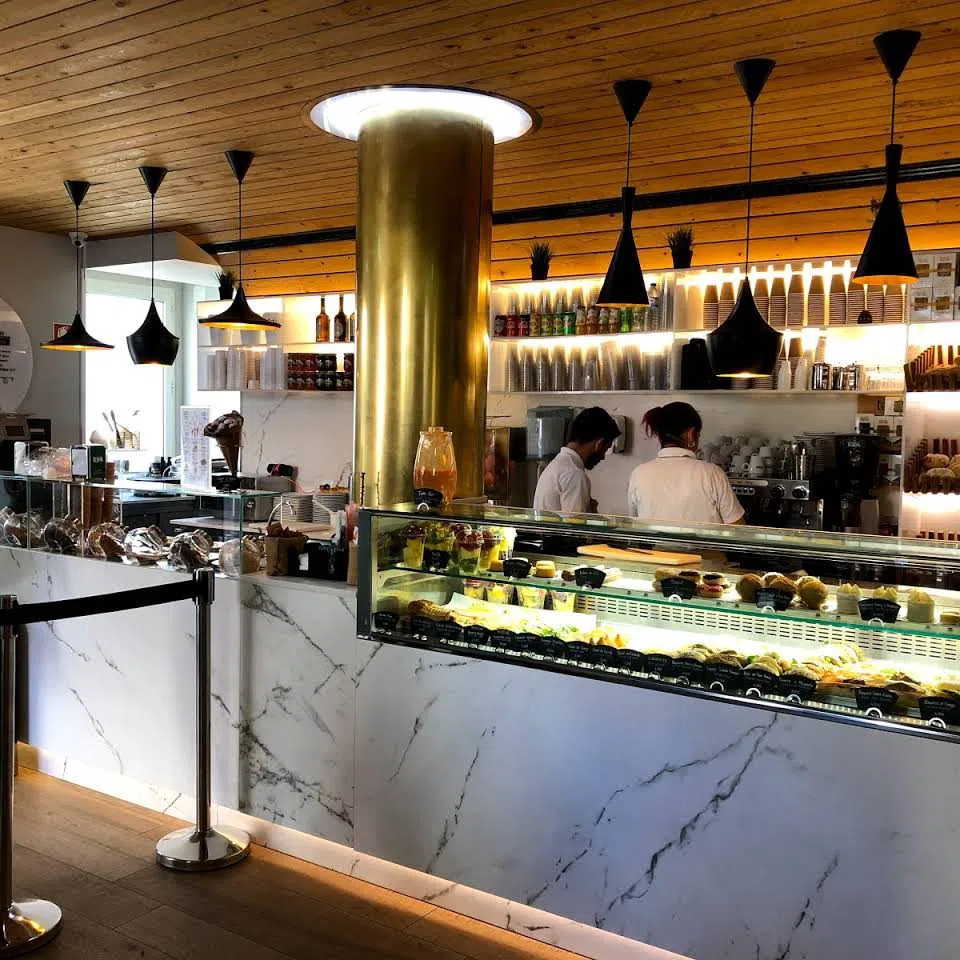
Pastelaria Santo António (Alfama, two minutes below the castle ticket office) is counter service, tiny, a couple of euros for a custard tart and a coffee, and a former winner of the city's best pastel de nata title. That combination makes it the sensible alternative to eating inside the walls. A group should order and take them outside instead of trying to occupy the room.
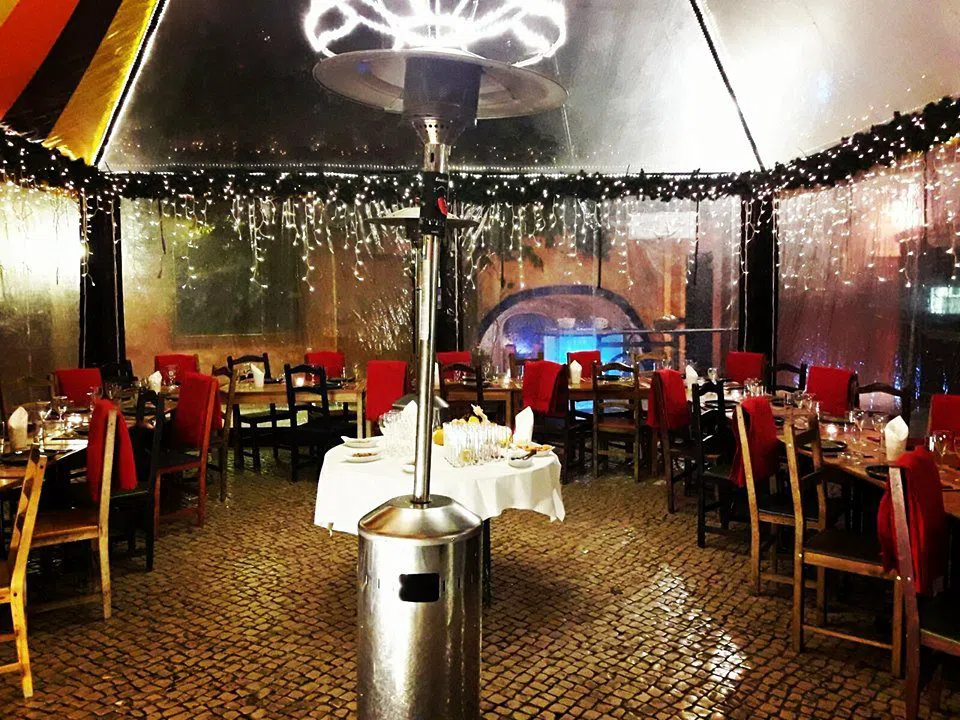
Chapitô à Mesa (Costa do Castelo) does the view-with-a-meal job at a fair price and funds a working circus school while it does it. The Esplanada runs 12:00 to 00:30 with the kitchen to 23:00 and is relaxed about walk-ins; the upstairs Panorâmico dining room opens from 18:30 and needs booking ahead by phone, WhatsApp or email. Terrace snacks and drinks cost noticeably less than the dining room.
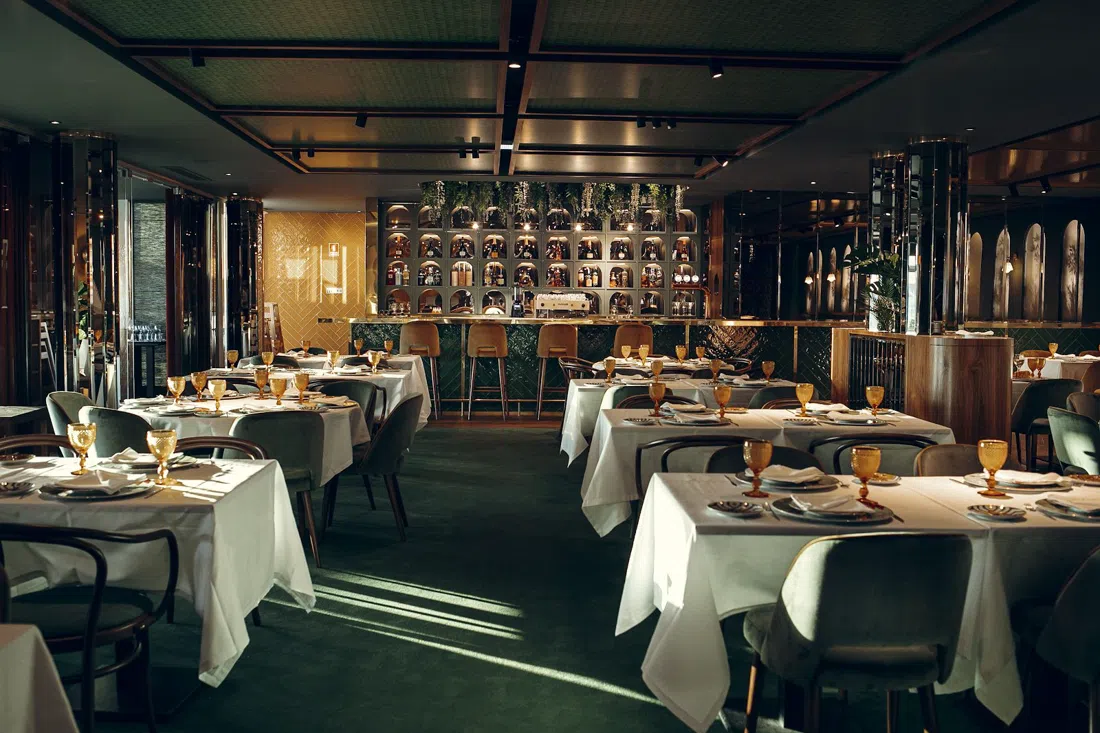
Zambeze Restaurante (Mercado do Chão do Loureiro, at the top of the free lift) is Portuguese cooking crossed with Mozambican flavours, mid-range to upper-mid, daily 10:00 to 23:00, reservations on +351 218 877 056. Three rooms and a large terrace mean it genuinely absorbs a group of ten, which very little else up here does, and it sits directly on the lift you were taking anyway.
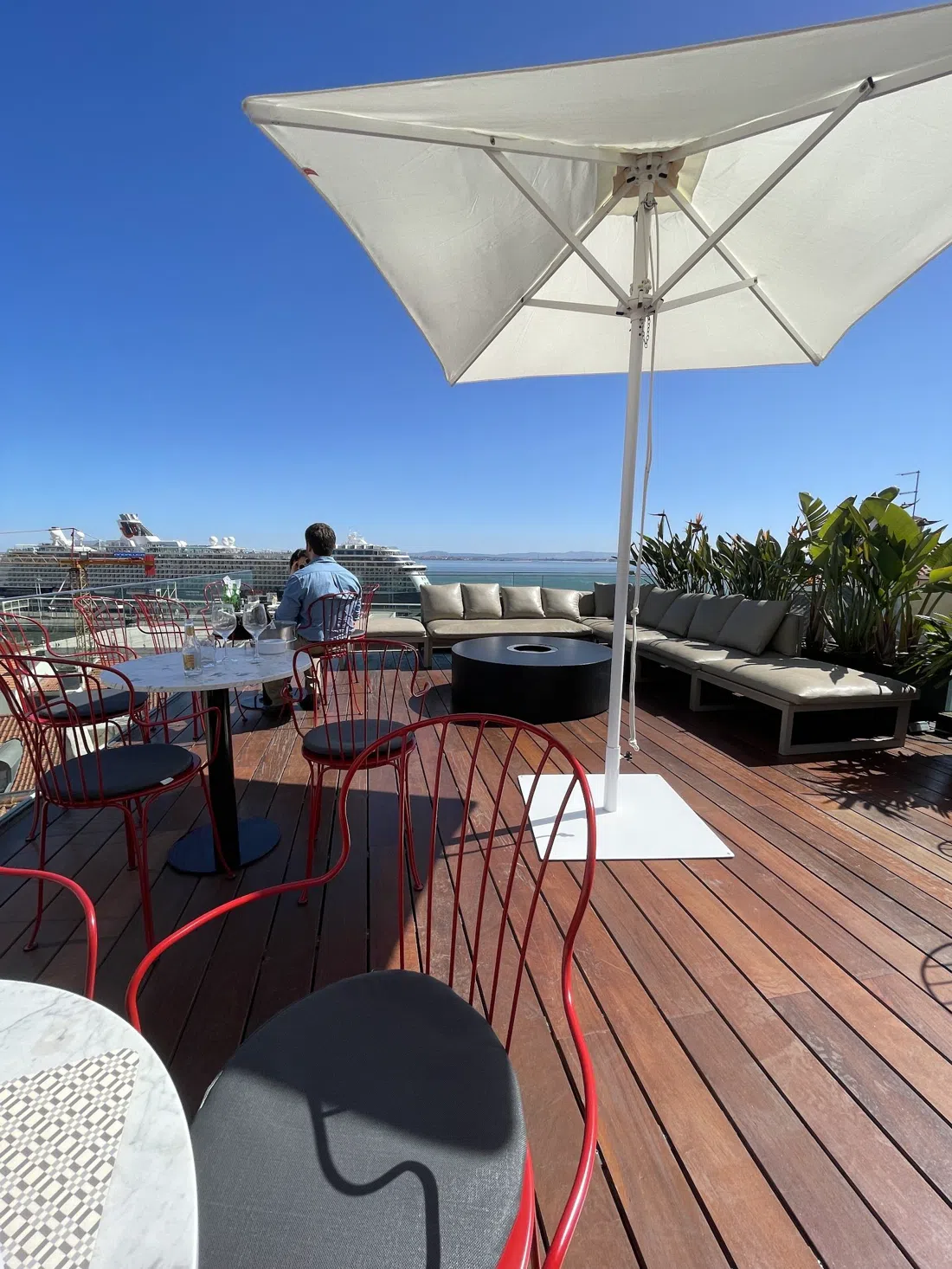
Wine Bar & Terrace at Memmo Alfama (Alfama) is the after rather than the during. Non-guests are welcome, the terrace runs 12:00 to 23:00 with wine service from 18:00, the pool is for hotel guests only, and prices are upper-mid for wine by the glass and Portuguese tapas. The terrace is small: fine for four, wrong for fourteen.
Seeing the castle instead of standing in it
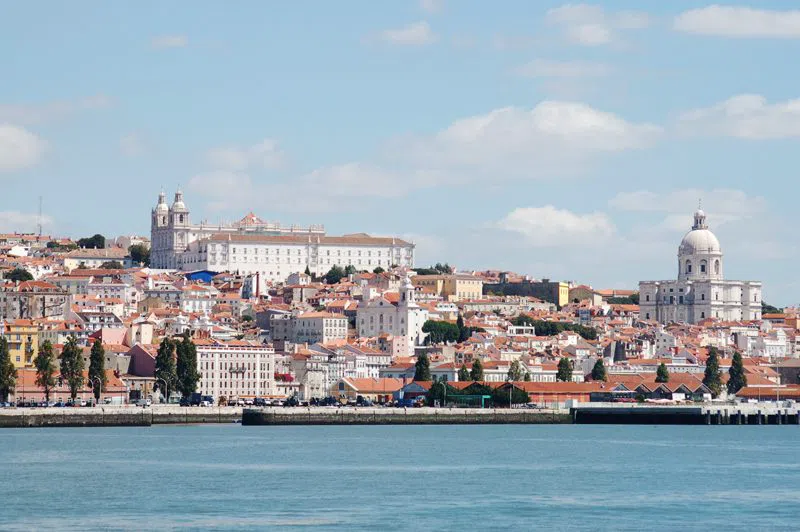
Two stops give you the walls in the frame. Mosteiro de São Vicente de Fora (Graça side of the hill) has azulejo galleries, the Braganza royal pantheon and a roof terrace that puts the castle in your photograph rather than under your feet. Paid entry, 25% off with the Lisboa Card, tickets on the door, and it rarely queues. Daily 10:00 to 19:00 June to October and 10:00 to 18:00 November to May, last entry an hour before close.
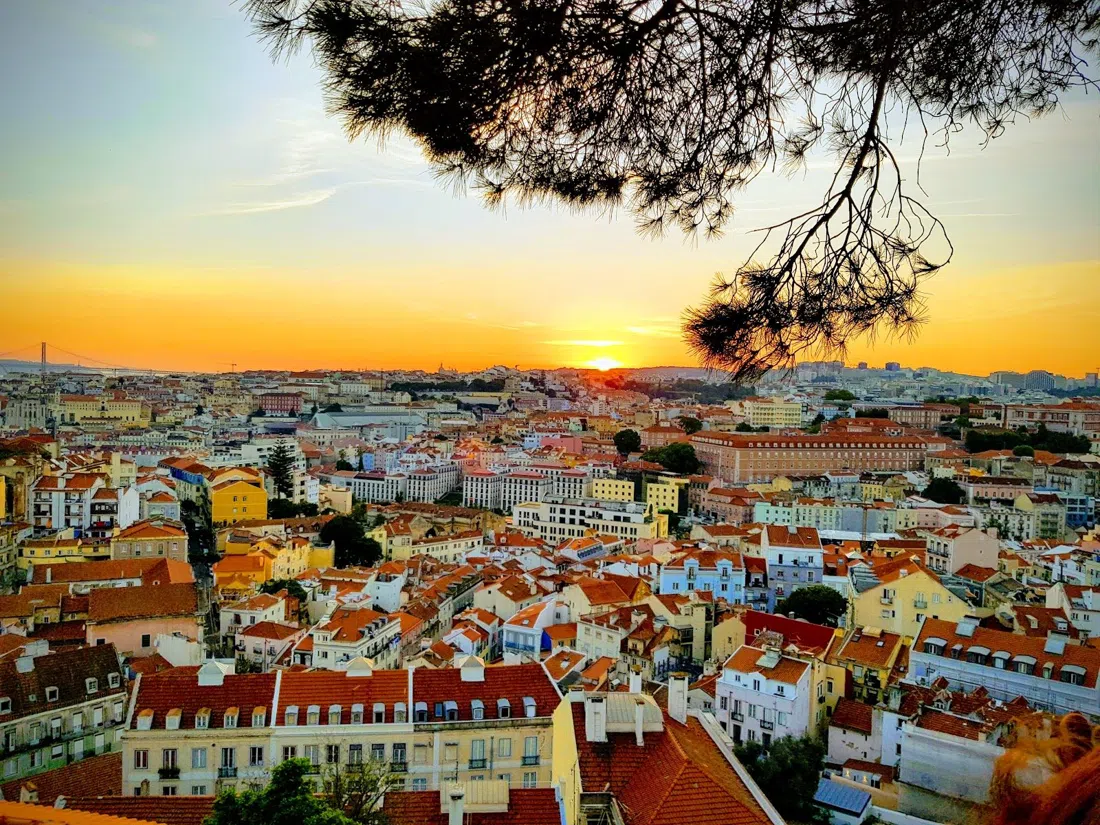
Miradouro Sophia de Mello Breyner Andresen, still known to everyone as Miradouro da Graça (Graça), is free, open and about ten minutes uphill from the castle gate. The sun sets behind the walls from here, which makes it the right last stop of the day; it is not a competitor to the castle terrace. Kiosk tables go early in the hour before sunset.
Best time to go
By hour, the first hour after the 09:00 opening is the best visit of the day in every season: thin crowds, soft light, and the ramparts still open for as long as you want them. The second-best window is the last two hours before closing from March to October, with the caveat that the towers shut before the gates.
By day, plan the hill around what is closed rather than around the castle, which opens daily. Mondays lose the Aljube and the Roman theatre. Tuesdays lose the decorative arts museum. Sundays lose the cathedral. A Wednesday or Thursday gives you the full hill.
By season, March to October gives you the long evening and the widest Camera Obscura hours. November to February shortens the castle day to 09:00 to 18:00 and narrows the Camera Obscura to a two-hour late-morning window, but hands you the terrace in near-solitude. If the sky is heavy, move the Camera Obscura down your list, since it needs light to work, and put the decorative arts museum in its place.
Is the €17 worth paying
Yes, on one condition: that you give it the walls and the exhibition and not just the terrace. As a viewpoint alone it is poor value, because Portas do Sol and Graça are free and the castle view is not dramatically better than either. As a site, it is the one place in the city where you can stand on the fortification, look down into the excavated layers underneath it and see the whole river bend at the same time, and that is worth three hours and €17.
It suits anyone who likes ruins they can walk on, families with under-12s who get in free, and photographers who can make the early slot. It suits you less if stairs and cobbles are a problem, if you have only two hours in the city, or if you mainly want the view, in which case take the free lift, drink at a terrace and keep your money.
Staying within walking distance of the gate
The hill is mostly apartments rather than hotels, which is why searches for apartments in the centre near Castelo de São Jorge turn up so much. Sleeping up here is genuinely good, since you get the castle at 09:00 before anyone else and the lanes back to yourself at night, but check three things before booking. Whether there is a lift, because four floors with luggage on a hill is a different holiday. How far the nearest car can actually drop you, since much of Alfama is too narrow for one. And whether the windows face the tram line, which starts early. Compare what is on the hill against the flatter, better-connected options below it with a Lisbon hotel search before you commit.
Practical notes
On transport, the free Elevador do Castelo lifts from Rua dos Fanqueiros run 07:00 to 21:00 and are the cheapest and least painful way up. Bus 737 is the useful bus. Tram 28 costs €3.30 on board against €1.90 on a Navegante or Viva Viagem card, and a 24-hour Carris and Metro pass is €7.25, worth it only if you are riding several times.
Cards work at the castle ticket office, the museums and the restaurants. Carry €10 or so in coins for the kiosk terraces and the bakery counter, where small orders and cash are simply faster.
On timing, allow three hours for the castle if you want the walls, the exhibition and a Camera Obscura slot. Add an hour for the cathedral, 30 to 40 minutes for the Roman theatre, and an hour for the Aljube. That is a full, honest day on one hill.
On budget, a full day of everything paid (castle €17, cathedral €7, decorative arts €10, Aljube €4, plus the Roman theatre at a few euros) lands near €40 a head before food. A tart and a coffee is a couple of euros; a terrace drink is €3 to €6; a mid-range meal with a view is the main variable. The two best viewpoints on the hill cost nothing at all. For the rest of the city around it, start from the Lisbon guide.